During a recent joint appearance, Donald Trump once again demonstrated his signature blend of blunt humor and political theater—this time with a remark that quickly ignited both laughter and controversy. Standing alongside Japanese Prime Minister Sanae Takaichi, Trump responded to a reporter’s question about military secrecy with an unexpected historical jab that referenced one of the most sensitive events in U.S.–Japan history: the Attack on Pearl Harbor.
The exchange began when a Japanese journalist pressed Trump on why the United States did not inform allies, including Japan, before carrying out recent strikes on Iran. The question touched on a longstanding issue in international relations: how much coordination should exist between allies when rapid military action is required. Rather than offering a conventional diplomatic response, Trump leaned into his characteristic improvisational style.

“We went in very hard and we didn’t tell anybody about it because we wanted surprise,” Trump said, defending the element of secrecy in military operations. Then, without hesitation, he pivoted to a remark that would dominate headlines: “Who knows better about surprise than Japan? Why didn’t you tell me about Pearl Harbor?” The comment, delivered with a rhetorical flourish, drew immediate reactions both in the room and across social media.
To understand the weight of that statement, it’s important to recall what the Attack on Pearl Harbor represents. On December 7, 1941, Japanese forces launched a surprise assault on the U.S. naval base in Hawaii, killing over 2,400 Americans and propelling the United States into World War II. The attack remains a defining moment in both American memory and U.S.–Japan relations, symbolizing the dangers of unanticipated military aggression. While the two nations are now close allies, the historical legacy still carries emotional and political sensitivity.
Trump’s remark appears to have been intended as a provocative analogy rather than a literal accusation. His rhetorical style often includes exaggerated comparisons and historical references designed to emphasize a point—in this case, the strategic value of surprise in warfare. Supporters argue that the comment was a sharp, if irreverent, way to underscore the necessity of secrecy in military planning. Critics, however, contend that invoking Pearl Harbor in a casual or humorous context risks trivializing a tragic event and undermines diplomatic decorum.
This moment is emblematic of Trump’s broader communication approach. Throughout his political career, Donald Trump has frequently departed from traditional presidential language, opting instead for unscripted, attention-grabbing statements. This strategy has proven highly effective in dominating news cycles and energizing his base, but it has also sparked repeated controversies, particularly in international settings where tone and nuance are closely scrutinized.
The presence of Sanae Takaichi added another layer of complexity to the exchange. As a prominent figure in Japanese politics, her role in the appearance highlighted the ongoing strength of U.S.–Japan relations, which have evolved significantly since World War II. Today, the two countries cooperate closely on economic, technological, and security issues, particularly in the Indo-Pacific region. Moments like this, however, illustrate how quickly historical memory can resurface in modern diplomatic discourse.
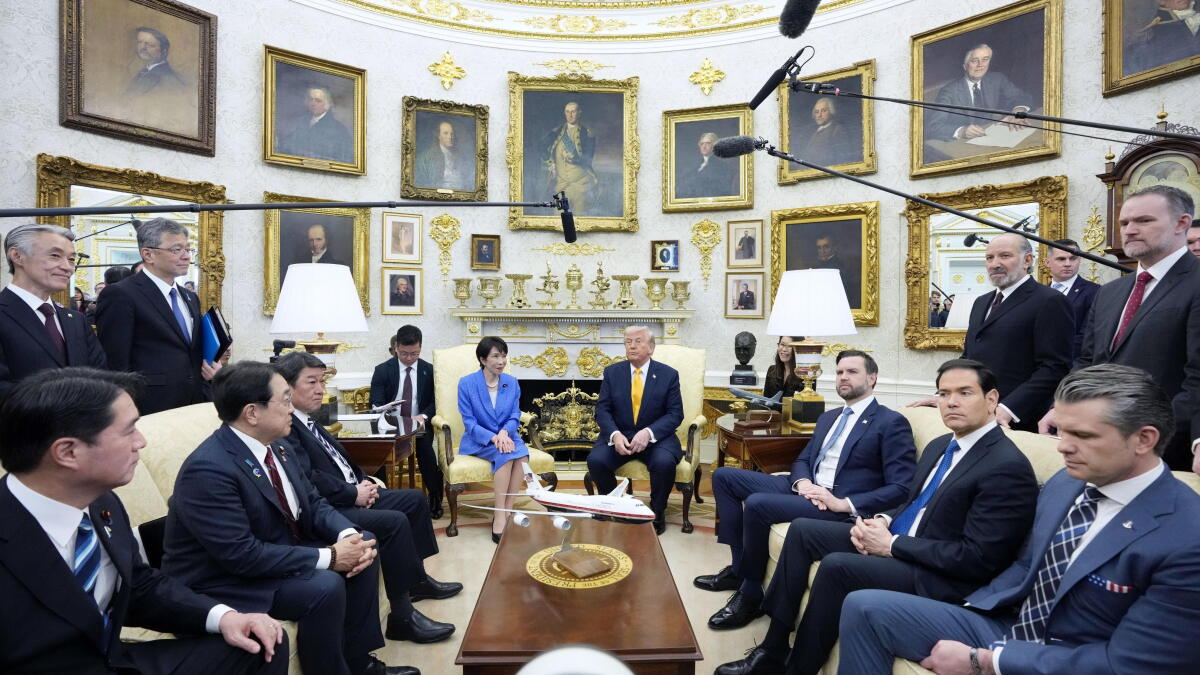
Beyond the immediate reaction, the incident raises broader questions about how leaders communicate in an era of instant global media. In the past, remarks made in a press conference might have remained relatively contained. Today, a single line can circulate worldwide within minutes, amplified by social media and interpreted through countless political and cultural lenses. Trump’s Pearl Harbor comment is a textbook example of how a brief, unscripted moment can become a focal point for debate about history, diplomacy, and leadership style.
It also reflects a deeper tension in American political communication: the balance between authenticity and restraint. Trump’s supporters often praise his willingness to speak candidly and reject what they see as overly polished political correctness. Detractors, on the other hand, argue that such candor can come at the expense of respect, accuracy, and strategic messaging—especially when dealing with allies and sensitive historical topics.
Ultimately, whether one views the remark as “legendary” humor or a diplomatic misstep depends largely on perspective. What is undeniable is its impact. In just a few sentences, Donald Trump managed to spark a conversation that spans decades of history, touches on the complexities of international alliances, and highlights the enduring power of words in politics.
As global tensions continue to evolve, moments like this serve as a reminder that communication at the highest levels is never just about the present. It is shaped by history, interpreted in real time, and remembered long after the headlines fade.