In Week 12, Philadelphia built what appeared to be an insurmountable 21–0 lead, powered by a passing attack that sliced through Dallas early. Yet as the game wore on, the offense stalled, momentum flipped, and a collapse unfolded. A unit that once controlled the tempo suddenly struggled to find rhythm, leaving the door wide open for a comeback that would ultimately reshape the narrative of the afternoon.
The contrast between the explosive first half and the scoreless second half was stark. Philadelphia failed to generate sustained drives, failed to manage the clock, and failed to balance their attack when it mattered most. A once-dominant offense became one-dimensional, weighed down by inefficiency on the ground and an inability to protect a sizable lead. That regression proved fatal in a matchup with high playoff implications.
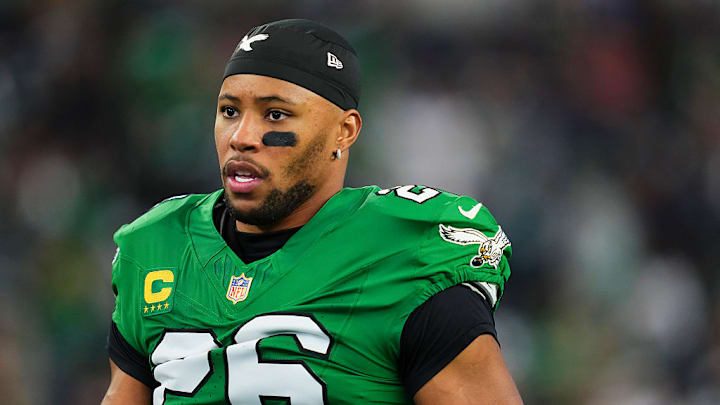
Much of the conversation now turns toward the star running back expected to anchor the ground game. Saquon Barkley, once the focal point of an elite rushing attack, has seen his production plummet. Limited opportunities and diminishing efficiency have made it difficult for the coaching staff to lean on him in critical situations. The result is a ground game that no longer threatens defenses the way it did a season ago.
Barkley’s struggles have not gone unnoticed, and he addressed them earlier in the week with a mix of honesty and frustration. “When the lanes aren’t there and the rhythm disappears, every carry feels heavier. I’m pushing, I’m grinding, but I know I haven’t delivered the way this team deserves,” he said, capturing the emotional weight of Philadelphia’s diminishing run identity.
The numbers illustrate the downturn clearly. After a dominant 2024 season with explosive efficiency, Barkley’s yardage, workload, and impact have dropped sharply. Philadelphia’s blocking has regressed, his contact balance has suffered, and the offense is forced to manufacture touches through the air just to keep him involved. What was once a nightmare for defenses has become a more predictable, easily contained element of the game plan.
This decline has forced the coaching staff to steer further into the passing game. Jalen Hurts continues to produce, but without a reliable run threat, defenses can adjust more aggressively, making Philadelphia’s offense easier to read in late-game situations. The shift from a balanced, imposing attack to a pass-dependent one leaves the team vulnerable, especially when protecting leads against high-powered opponents.
Defenses, no longer intimidated by the run, crowd passing lanes and pressure Hurts into tougher decisions. Meanwhile, the lack of production on early downs often sets up unfavorable third-down situations, disrupting the flow of drives. Even with elite receivers who consistently create separation, the offense struggles to sustain momentum without complementary efficiency on the ground. The cumulative effect has repeatedly shown up in second-half stagnation.
The path forward for Philadelphia is becoming increasingly clear. While Barkley played a pivotal role in last year’s championship run, the current reality demands a shift in identity. The offense must flow through Hurts, A.J. Brown, and DeVonta Smith if the team hopes to contend again. Until the run game regains its explosiveness, the Eagles will need their aerial firepower to carry the weight of another postseason push.