FOXBOROUGH — While much of the national conversation after the Patriots’ crushing Super Bowl LX defeat to the Seattle Seahawks centered on New England’s exposed offensive line and inconsistent run game, the front office led by Eliot Wolf was already working quietly behind the scenes on a calculated solution.
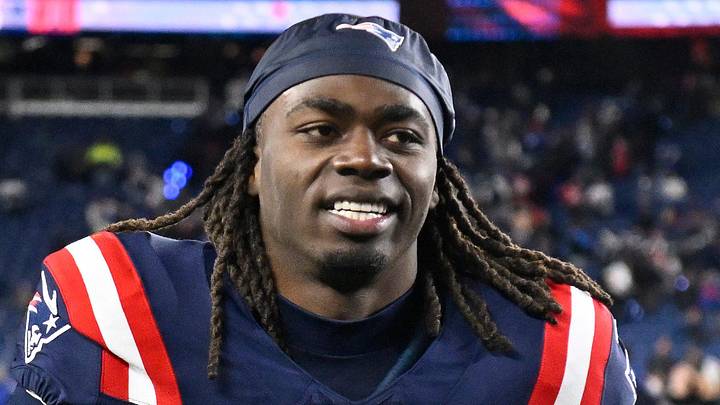
Far from a flashy headline-grabbing rebuild, the Patriots executed a focused, blue-collar overhaul designed to transform their ground attack into a legitimate weapon. And at the center of this resurgence stands a running back many had written off: Rhamondre Stevenson.
According to The Athletic’s Chad Graff, Stevenson has emerged as the clearest winner of the Patriots’ 2026 offseason. After a season that began with visible struggles, the veteran back regained his rhythm and confidence when it mattered most. Now, with significant reinforcements arriving, he is poised for a breakout campaign as the undisputed RB1.
Addressing the Root Problem
The Patriots’ offensive line woes were painfully evident throughout the playoffs, culminating in a dismal performance in the Super Bowl. Rather than overhauling the entire scheme, New England took a surgical approach to fix the trenches:
- They shifted Jared Wilson into his natural position at center, where he is expected to thrive.
- They signed proven Pro Bowl-level left guard Alijah Vera-Tucker to anchor the interior.
- They added quality depth across the offensive line.
- They brought in elite fullback Reggie Gilliam, one of the league’s best in his role.
- They added big-bodied blocking tight end Julian Hill, a player with a proven reputation as an extra offensive lineman in the run game.
This is not just incremental improvement — it’s a deliberate construction of a run-game juggernaut.
As Graff noted:
“So the team found an upgrade at left guard and a young center who could have a breakout season while adding one of the league’s best fullbacks and signing a blocking tight end, all in the name of developing a more consistent run game. That should go a long way toward benefiting Stevenson, who still projects as the starter over TreVeyon Henderson.”
A New Identity for Stevenson and the Patriots
For Stevenson, the additions are transformative. Last season, he was forced to create yardage against stacked boxes and behind a shaky offensive line. Despite the challenges, he showed resilience, finishing strong and earning the trust of teammates and coaches. Now, he will operate behind a significantly upgraded unit built specifically to create lanes and wear down defenses.
The vision is clear: a physical, methodical run game that sets up play-action opportunities for quarterback Drake Maye, controls the clock, and keeps defenses guessing. With Gilliam and Hill serving as lead blockers, Stevenson should see more room to operate between the tackles — the style of football he excels at.
This offseason strategy reflects a mature understanding from Wolf and the coaching staff. Instead of chasing skill-position talent in a crowded market, they invested heavily in the foundation — the often-overlooked “fifth of the offense” that wins games in January and February.
The 2026 Outlook
If the new-look offensive line performs as expected, the ripple effects could be significant. A healthy, confident Rhamondre Stevenson running behind this group has the potential to become one of the most productive backs in the AFC. More importantly, it gives the Patriots the balance they’ve lacked for years — a legitimate threat to run the football consistently, regardless of game script.
The narrative around Stevenson has shifted dramatically. Once viewed as a product of a strong supporting cast, he is now positioned as the featured back in a system designed to maximize his strengths.
The Patriots didn’t just patch holes this offseason. They quietly built a run game identity around a player many had forgotten. Come September, Rhamondre Stevenson may be ready to remind the entire league why he belongs among the elite.