It was supposed to be just another farewell week in late-night television. One final round of applause. One last monologue behind the desk that had carried nearly 11 years of political satire, celebrity interviews, and cultural commentary. But by the time the lights dimmed inside the Ed Sullivan Theater, the ending of Stephen Colbert’s era no longer felt like ordinary television. It felt like the closing scene of something much bigger — a battle over comedy, power, media, and who still gets to control the conversation in America.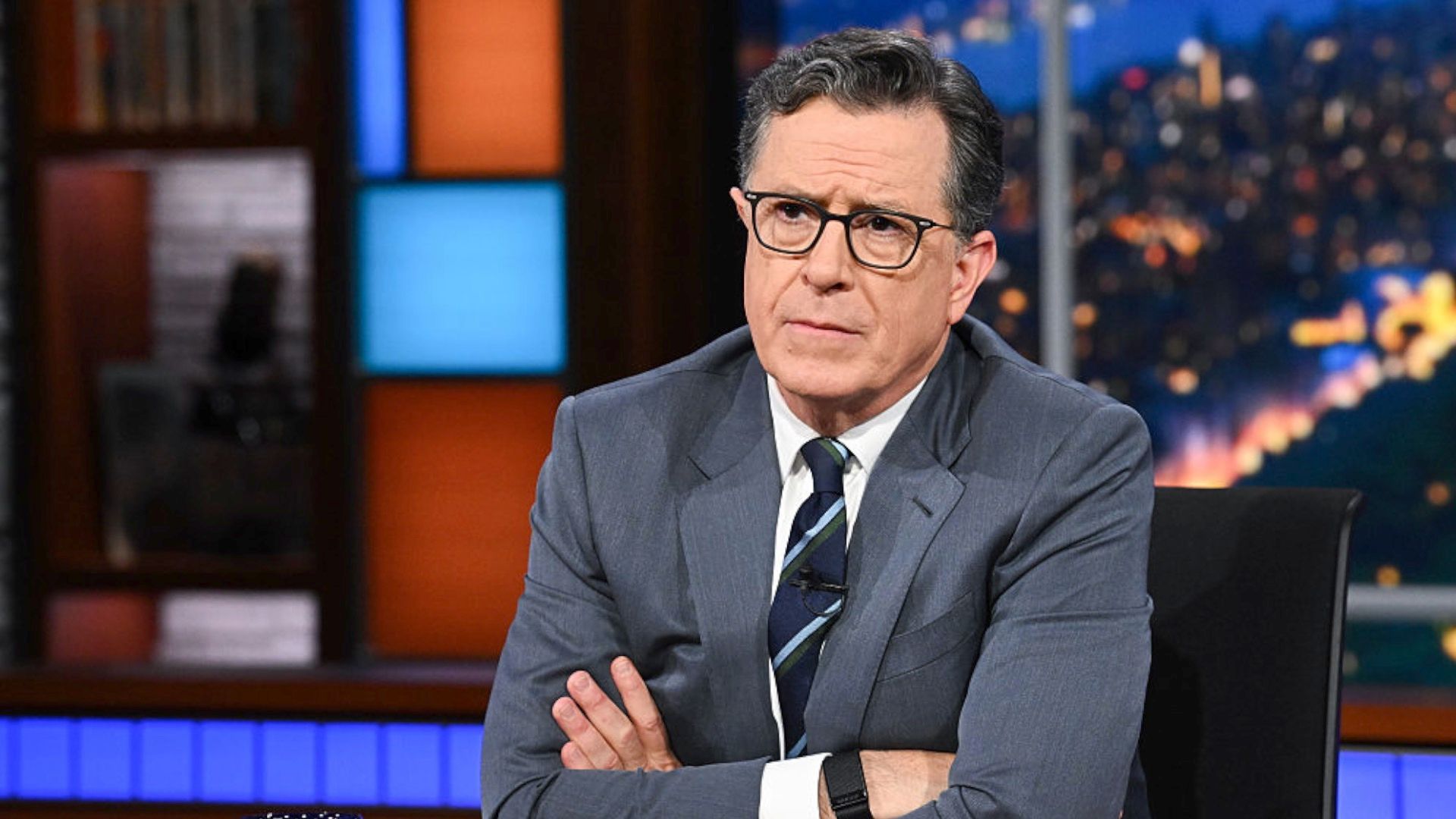
For weeks, rumors had circled around CBS, Paramount, and the future of late-night television. Executives insisted the decision was financial. Reports pointed to mounting losses, shrinking ad revenue, and changing viewing habits in the streaming age. Publicly, the network framed the cancellation of The Late Show with Stephen Colbert as business. Quietly, critics wondered whether politics had entered the room long before the official explanation arrived.
Then came Bruce Springsteen.
The legendary musician walked onto Colbert’s stage during the show’s final stretch carrying far more than a guitar. For many viewers, the performance immediately felt symbolic. Springsteen, long associated with blue-collar American storytelling and public criticism of Donald Trump, stood beside one of Trump’s most outspoken late-night critics on the very week that critic was preparing to leave network television.
The timing alone ignited speculation online.
Donald Trump had spent years attacking Colbert publicly. At rallies, in interviews, and across social media, the president repeatedly mocked the host as “talentless,” “pathetic,” and “a trainwreck.” The insults became so familiar that viewers almost expected them whenever Colbert’s name appeared in headlines. But this time felt different because the stage was disappearing.
For Trump supporters, Colbert’s exit represented the collapse of a style of late-night television they viewed as partisan and hostile. For Colbert’s fans, the cancellation looked suspiciously timed amid Paramount’s massive corporate transition and ongoing regulatory scrutiny surrounding the Skydance merger. The official explanation remained financial. The internet refused to leave it there.
Behind the scenes, Paramount’s $8.4 billion merger with Skydance had already transformed Hollywood into a pressure cooker. Executives denied any political connection to Colbert’s departure, emphasizing the reported losses tied to the show. Yet critics noticed how carefully every public statement was worded. Nobody wanted to say more than necessary. Nobody wanted to trigger another media war.
Then David Letterman entered the conversation.
The former late-night king, whose shadow still hangs over the Ed Sullivan Theater, reportedly questioned the timing of the cancellation and openly challenged the narrative that money alone explained the decision. Jimmy Kimmel voiced skepticism as well. Suddenly, the story stopped being about one host losing a show. It became a referendum on whether corporate media still protects controversial voices when politics and business collide.
That tension only intensified once Springsteen appeared.
For decades, Springsteen has represented a version of America rooted in working-class frustration, disillusionment, and resilience. Trump had criticized him repeatedly in recent years, accusing celebrities like “The Boss” of speaking down to ordinary Americans while claiming to represent them. So when Springsteen stepped onto Colbert’s stage during the final days of the show, viewers instantly interpreted it as more than entertainment.
No direct political speech was necessary.
The symbolism carried itself.
Social media exploded almost immediately. Clips spread across TikTok, YouTube, X, and Instagram with captions calling the moment “a quiet protest,” “the last stand of old late-night,” and “Hollywood’s final shot before the lights go out.” Supporters praised Colbert for refusing to soften his voice until the very end. Critics argued the performance only proved why audiences had tuned out modern late-night comedy in the first place.
And through it all, Donald Trump stayed publicly silent.
That silence became its own headline.
Normally, Trump responds quickly when celebrities criticize him or when media moments begin trending nationally. But as clips from Colbert’s farewell week spread online, there was no immediate post targeting Springsteen, no direct attack on the performance, no instant Truth Social rant mocking the ratings or audience. Reporters noticed. Commentators noticed. Supporters noticed.
The silence lingered.
Inside the theater, however, Colbert appeared remarkably calm. Those who attended described an atmosphere that felt emotional but strangely controlled. No screaming farewell. No dramatic meltdown. Just a host who seemed fully aware that television history was closing around him in real time.
That calm may have made the ending hit even harder.
For nearly 1,800 episodes, Colbert transformed The Late Show into one of the central stages of political satire in America. His monologues became nightly reactions to Trump-era politics, legal battles, scandals, elections, and media wars. Admirers called him fearless. Opponents called him obsessed. Either way, few denied his influence.
Now the desk itself was disappearing.
The larger fear haunting Hollywood was impossible to ignore. If a figure as established as Colbert could vanish during a period of corporate consolidation and political tension, what did that mean for the future of openly confrontational comedy on network television? Could sharp political satire survive inside increasingly cautious media corporations? Or was late-night entering a safer, quieter era designed to avoid controversy altogether?
Nobody seemed certain.
Meanwhile, older viewers watching the farewell week experienced something more personal. For decades, late-night television served as a national ritual — Letterman, Leno, Conan, Stewart, Kimmel, Colbert. These hosts shaped political humor for entire generations. Seeing one of the last giants leave under a cloud of controversy felt less like a cancellation and more like the end of a cultural era.
And then came the final applause.
No matter which side viewers stood on politically, the image carried weight: Stephen Colbert standing beneath the theater lights while Bruce Springsteen performed nearby, critics questioning corporate motives, comedians defending one another publicly, and a president who had spent years attacking the host suddenly saying nothing at all.
In the end, that may be why the moment lingered so strongly online.
Because it no longer looked like a simple television cancellation.
It looked like a snapshot of modern America itself — entertainment, politics, billion-dollar media deals, celebrity influence, public outrage, and silence all colliding on one stage during the final week of a late-night show that refused to stop talking until the curtain finally fell.