When the final whistle echoes through Lincoln Financial Field and more than seventy thousand fans stream into the Philadelphia night, most assume the story of the game has ended. In reality, another chapter begins long after the crowd is gone.
Under the stadium’s still-burning lights, the Philadelphia Eagles have launched an initiative that is already generating intense debate far beyond the NFL. After every weekend home game, the organization will hire homeless individuals to help clean the stadium, paying $20 an hour, along with providing hot meals and drinks during overnight shifts.
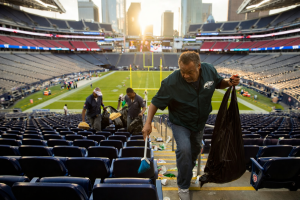
The decision, announced quietly but quickly amplified online, has ignited widespread discussion across sports media, political commentary, and social platforms. Supporters view the program as a meaningful and practical response to homelessness, while critics argue it risks blurring the line between social responsibility and public relations.
According to the Eagles, the initiative is designed in partnership with local nonprofits and homelessness outreach organizations. Participation is voluntary, coordinated through trusted community groups, and intended to provide immediate income and short-term stability for individuals facing housing insecurity. Team representatives have emphasized that the program is not positioned as a solution to homelessness, but rather as an opportunity to engage rather than ignore.
Fans who support the initiative argue that paid work offers dignity in a way symbolic gestures often fail to deliver. They note that $20 an hour represents fair compensation for physically demanding overnight labor and that providing food and basic care demonstrates respect, not obligation. For some, the program reflects a franchise using its resources and influence to address real conditions in its host city.

Critics, however, see the situation differently. They question whether cleaning a billion-dollar stadium owned by a wealthy franchise truly constitutes empowerment, or whether it highlights deeper structural inequalities. Several commentators have argued that celebrating temporary labor risks normalizing a system in which survival depends on cleaning up after spectators who can afford premium seating and luxury suites.
The debate intensified as images circulated online showing workers cleaning high-end seating areas and private suites. For critics, those images became symbols of the imbalance between wealth and labor that defines professional sports. Others countered that discomfort is necessary if society is ever to confront inequality honestly, and that rejecting imperfect initiatives ensures no action at all.
Homelessness advocates have offered more nuanced perspectives, acknowledging both the immediate benefits and the limitations of the program. Many agree that fair pay, respectful treatment, and human interaction can provide meaningful short-term relief. At the same time, they caution against framing temporary employment as long-term empowerment without pathways to housing, healthcare, and sustainable jobs.
Some advocates have urged the Eagles to expand the initiative into broader workforce development programs, while others have called for transparency to ensure participants are protected and not pressured to participate. The phrase “one shift does not equal a second chance” has become a recurring theme in online criticism.
Largely absent from the broader debate are the voices of the workers themselves. Several participants, speaking anonymously through partner organizations, described the work as physically exhausting but emotionally significant. Some cited the importance of being treated with respect, receiving fair pay, and feeling useful after long periods of isolation. One participant described the experience as “being seen again.”
As the conversation grows louder, the NFL is watching closely. Fans of other franchises have begun questioning why similar programs are not being implemented in cities facing comparable homelessness crises. In that sense, the Eagles’ decision has shifted the discussion from a single initiative to the league’s broader social responsibility.
Whether the program becomes a model for other teams or remains a standalone effort is still unclear. What is certain is that the Eagles have forced a conversation many prefer to avoid. Long after the stadium is cleaned and the headlines fade, the questions raised by this initiative will continue to resonate well beyond football.