Taylor Decker has never been the loudest voice in the Detroit Lions locker room. He has never chased headlines, and he has never needed words to prove his value. For nearly a decade, he has done his talking the same way offensive linemen always do — in the trenches, through pain, through anonymity, through sacrifice.
But after Detroit’s latest win, Decker finally stepped in front of the cameras and allowed the public to see something the box score and injury report never will.

Playing Through More Than a Dislocated Finger
On paper, Decker’s injury was listed plainly: a dislocated finger. Painful, yes — but in NFL terms, almost routine. Something you tape up, numb, and push through.
And push through he did.
Decker took the field knowing every snap would send a jolt through his hand. He blocked. He absorbed contact. He finished the game. Teammates praised his toughness. Coaches nodded approvingly.
Then the game ended — and the real weight surfaced.
Standing at the podium, Decker’s voice wasn’t steady. It wasn’t performative. It cracked.
“I’m Not in a Good Mental Place”
Decker didn’t dramatize his words. He didn’t exaggerate. He simply told the truth.
He admitted he’s struggling mentally. That the pain doesn’t stop when the game ends. That sleep has become rare. That the grind of waking up every morning knowing you still have to suit up — regardless of how your body feels — has taken a toll.
This wasn’t about toughness. It was about exhaustion.
Physical exhaustion, yes — but more than that, emotional and mental fatigue. The kind that accumulates over years, not weeks. The kind that no toughness badge can erase.
“I believe I can still play,” Decker said.
That sentence mattered.
Because it was immediately followed by another.

When He Mentioned His Kids, the Room Changed
Then Decker mentioned his children.
And everything shifted.
There was no dramatic pause. No grand statement. Just a quiet acknowledgment that football doesn’t exist in isolation anymore — not when there are little faces waiting at home, not when pain doesn’t stay confined to Sundays.
In that moment, it became clear this wasn’t about a finger.
It was about balance.
It was about longevity.
It was about the invisible line every veteran eventually approaches — the one between continuing because you can, and stepping away because you should.
No one said the word “retirement.”
But everyone in the room felt it.
A Career at the Edge of a Question
Taylor Decker has been a pillar of the Lions’ rebuild. Through losing seasons, coaching changes, and cultural resets, he remained. Reliable. Professional. Unwavering.
He has protected quarterbacks. Anchored lines. Set standards.
And now, quietly, he stands at a crossroads many great players reach without warning.
Can I keep doing this?
And if I can… what does it cost the people who matter most?
These aren’t questions that show up on stat sheets. They don’t factor into depth charts or salary cap spreadsheets. But they are the ones that linger when the locker room empties and the noise fades.
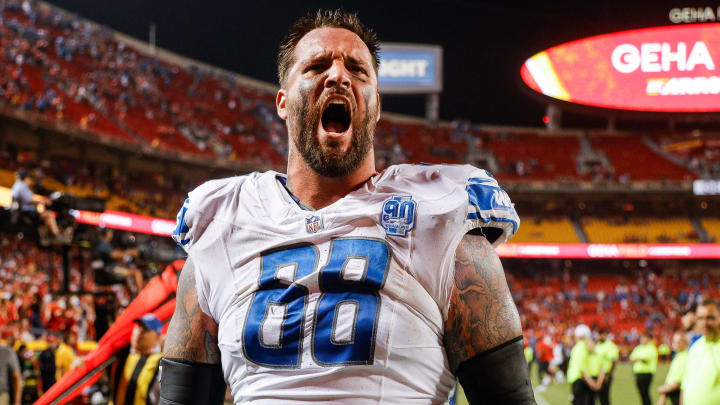
Respect Inside the Locker Room
Inside the Lions’ building, Decker’s words landed heavily — not as concern, but as respect. Teammates understand exactly what he meant. Many are fighting the same battles privately. Few are brave enough to say it out loud.
Coaches did not frame his comments as weakness. They saw honesty.
And in today’s NFL, that honesty matters.
This team has been built on accountability, trust, and human connection — not just results. Decker’s moment didn’t fracture that culture. It reinforced it.
Not a Goodbye — But a Moment That Matters
This was not a retirement announcement.
Taylor Decker made that clear.
He believes he can still play. He intends to keep fighting. He will suit up as long as he feels he can give his team what it deserves.
But moments like this linger.
They sit quietly at the back of conversations. They change how people listen. They remind everyone that football careers don’t always end with press releases or farewell tours. Sometimes, they approach the edge slowly — one painful night, one honest admission at a time.
Whatever comes next for Taylor Decker, this moment will be remembered — not for the injury, but for the humanity behind it.
Because for the first time, one of Detroit’s toughest veterans showed the pain no injury report ever will.
And it mattered.